London Field’s School Children Conceive Pioneering Community Hubs for Hackney Marshes
On the 10 March 2026, Year 5 pupils from London Fields Primary School gathered at The Art House by Acrylicize – an arts and design space in Bethnal Green – for the unveiling of their co-design project with GEO JAM. The event marked the culmination of a six-week collaboration that tasked the children with a compelling brief: to imagine how community facilities on Hackney Marshes can be made resilient in the face of climate change.
This project – CCAC’s second to complete in academic year 2025/26 – was led by architect Georgia Trower, co-founder of GEO JAM. She introduced pupils to the basics of architectural thinking, encouraging them to tackle design challenges posed by global warming.
The project focused on Hackney Marshes, a large tract of open land important to the local community. The children explored its history as floodplain common land, shaped by centuries of shared use, and its present-day role as a biodiverse habitat and vital recreation space for East London. With this knowledge, they began imagining how the Marshes and its community facilities could adapt to the challenges of a changing climate.
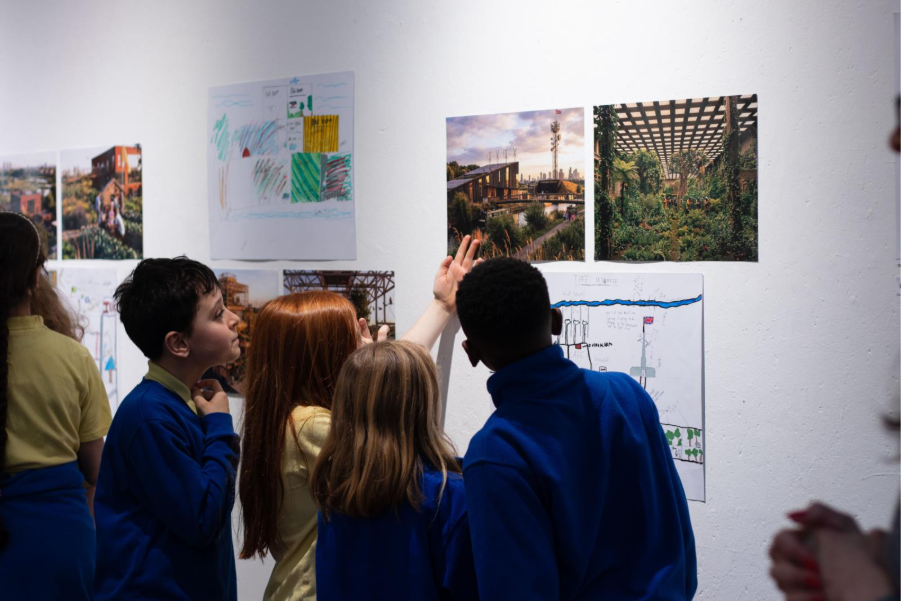
The children recognise their design concept in GEO JAM’s digital renders
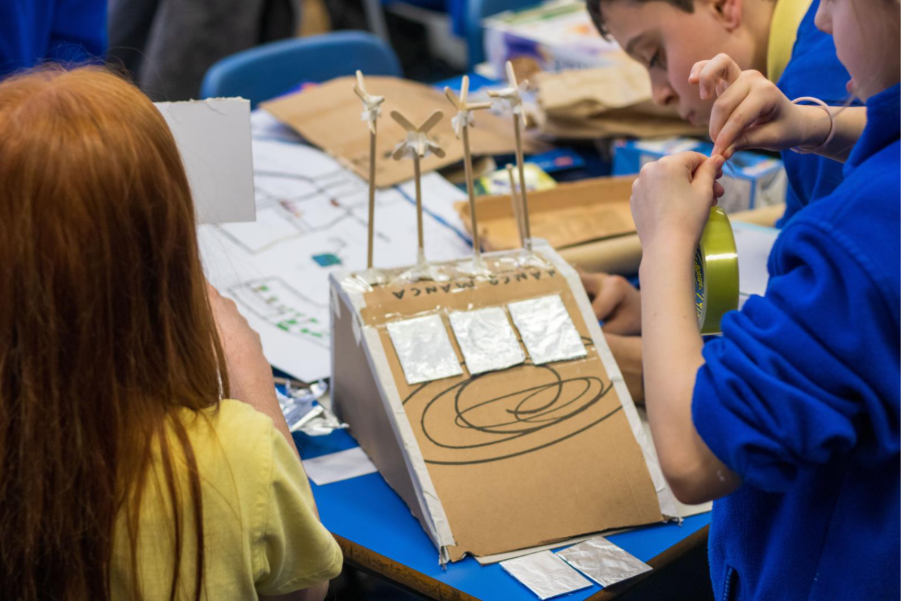
The co-design project introduced the pupils to professional techniques including site-mapping, model-making, and understanding what comprises ‘sustainable’ materials. Georgia explains: “The children integrated real environmental data into their projects by analysing wind patterns, sun paths and flood maps, identifying optimal sites for their community centre and rationalising their design decisions.” This hands-on engagement with data allowed the 9-and-10-year-olds to ground their imaginative ideas in practical reality.
All the projects incorporated sources of renewable energy, flood protection and repurposed materials. Proposals for the community facilities included a bird sanctuary; an underground café set into the riverbank with below water level views of the river’s aquatic life; a multi-functional building on stilts to keep people safe when the Marshes flood; and roof-top playgrounds.
The children first set down their ideas on paper, then made 3D models with lollipop sticks, cardboard, foil and tissue paper to emphasise the building’s adaptive features. In the project’s sixth week, they presented their work to an expert panel, demonstrating not only their creativity but also describing the rationale behind their design choices, how each proposal would serve the community, and articulating how their designs respond to climate extremes.
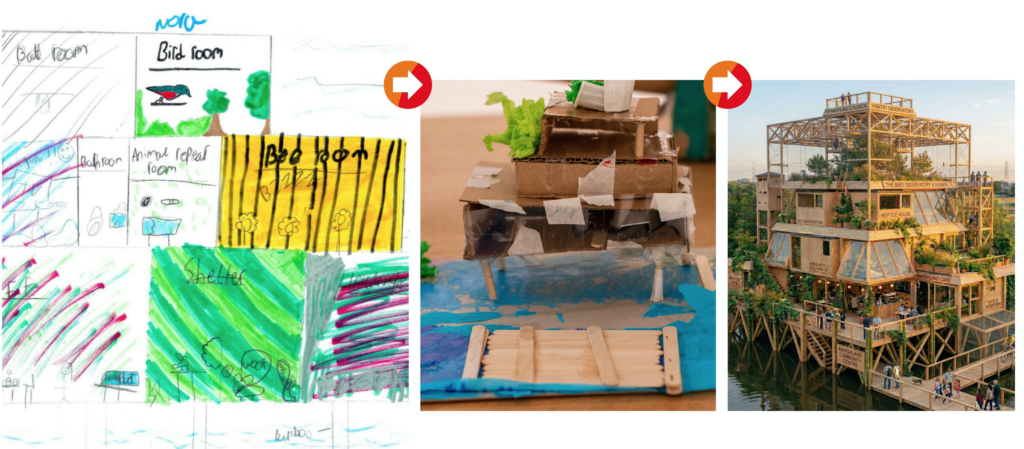
Evolution of one child-team’s design: their concept study and physical model, followed by GEO JAM’s digital render of the children’s design
The Art House by Acrylicize generously lent their gallery for Georgia’s Reveal of her digital interpretations of the children’s concept design. As she revealed her translation of every child-team’s model, the room filled with gasps and excited chatter from pupils, parents and teachers. Seeing their ideas rendered into client-ready images offered a powerful validation of all the children’s efforts.
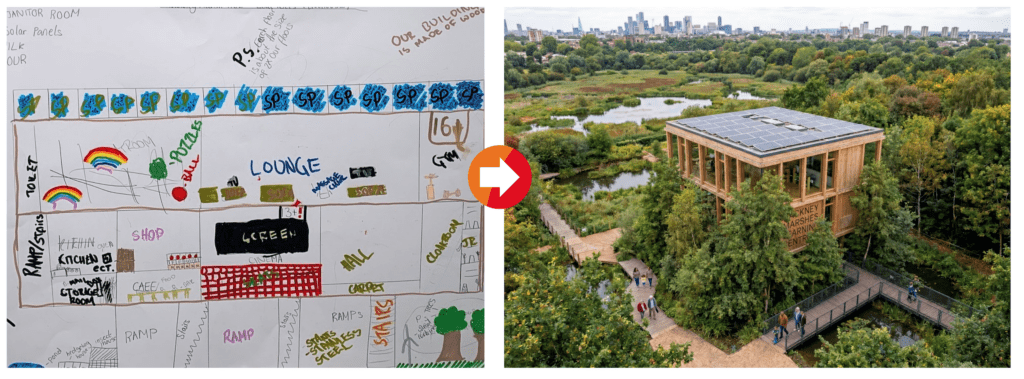
Children’s design followed by Georgia’s render
CCAC extends its sincere gratitude to Georgia Trower, GEO JAM co-founder Jamie Harrington, the team at Acrylicize, and the staff and pupils of London Fields Primary School for their dedication and creativity. It is our hope that this experience has equipped a small cohort of Gen A with a deeper understanding of how design can shape resilient, inclusive communities and that they feel empowered to contribute to that future.
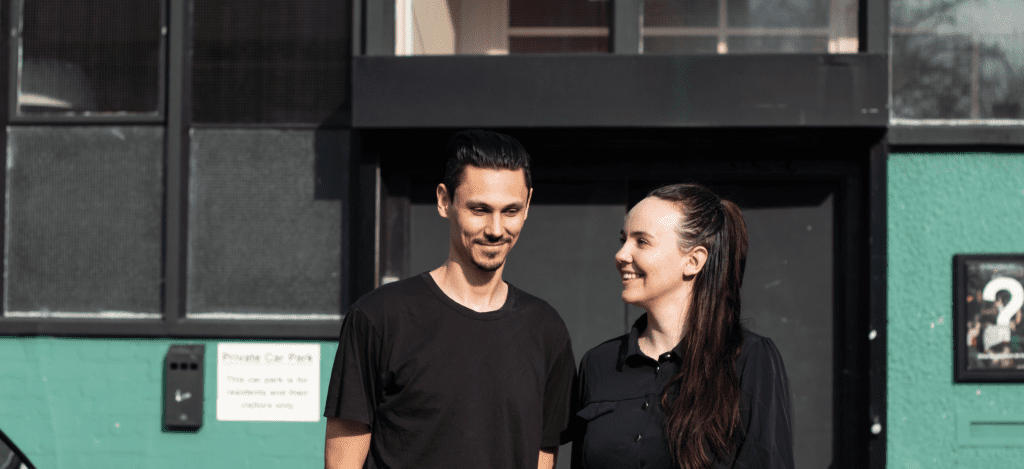
Co-founders of GEO JAM, Jamie Harrington and Georgia Trower outside The Art House by Acrylicize