Reimagining Hampstead Heath: Rosary RC children Co-Design a Climate Resilient “Oasis”

The journey began with a bold premise: what would happen if Hampstead Heath, one of London’s most cherished green spaces, became a desert due to extreme climate change?
This was the brief set for Year 5 pupils at Rosary RC Primary School. They were tasked with imagining a future for healthcare in a landscape that has completely dried out. The project focused on the creation of a sustainable “Oasis” – a sanctuary designed for ecological recovery to support the wellbeing of patients from the nearby Royal Free Hospital. Inspired by the Heath’s Maggie’s Centre, the children linked the health of the planet to the health of the local community, and were encouraged to think about architecture as a tool for empathy and resilience.
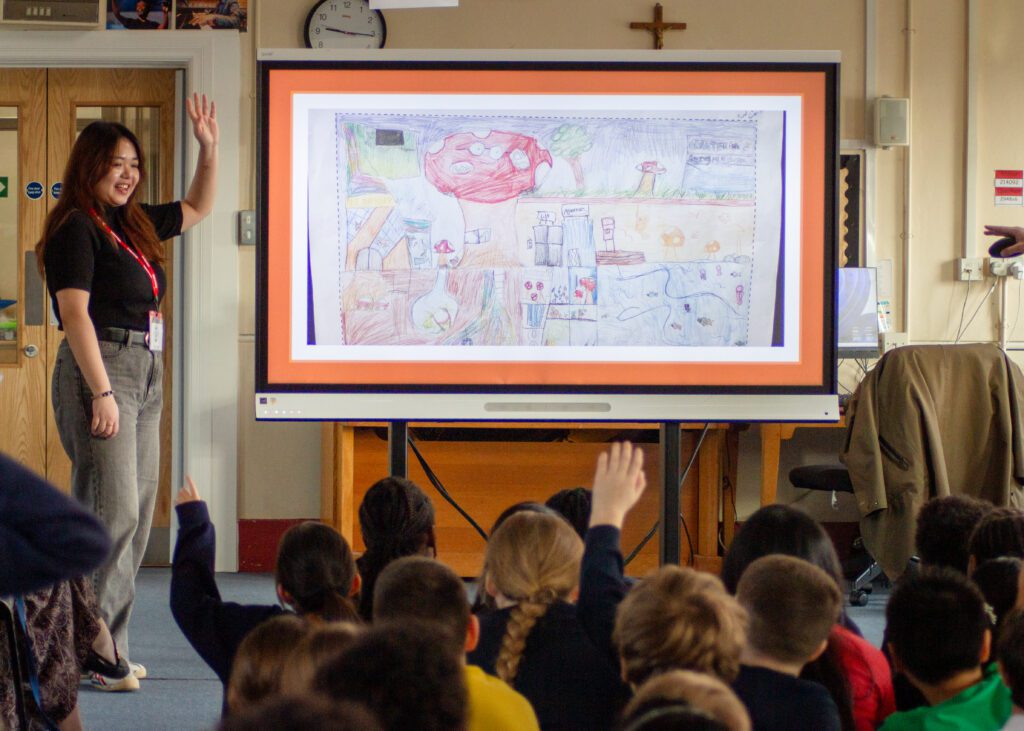
Sheppard Robson Architect Jing Zhi Tan presenting the reveal to Year 5 pupils.
To bring these visions to life, the students collaborated with senior architects Jing Zhi Tan and Jasneil Singh Panesar from Sheppard Robson. Over five weeks, the classroom transformed into a design studio where professional expertise met youthful imagination. Over the course of the workshops, the children learnt what design-thinking goes into the process of designing a functional building. Under the mentorship of the Sheppard Robson team, the children explored complex concepts like net-zero design and the circular economy, discovering innovative materials like timber and recycled glass as inspiration for their own ideas.
“I learned that if I don’t use one thing, it doesn’t mean I have to throw it away. There was a material we were shown that was made of crushed-up CDs… you can smash it up and make it into something else.” – Yr5 child from Rosary RC Primary School
The resulting designs showed an impressive ability to problem-solve under time constraints. Their proposals featured ideas to combat extreme heat, such as subterranean restaurants, spas, and interconnected glass “orbs” submerged in water to provide natural cooling. “The Sustainable Strawberry” team even incorporated ventilation via the strawberry’s “seeds”.
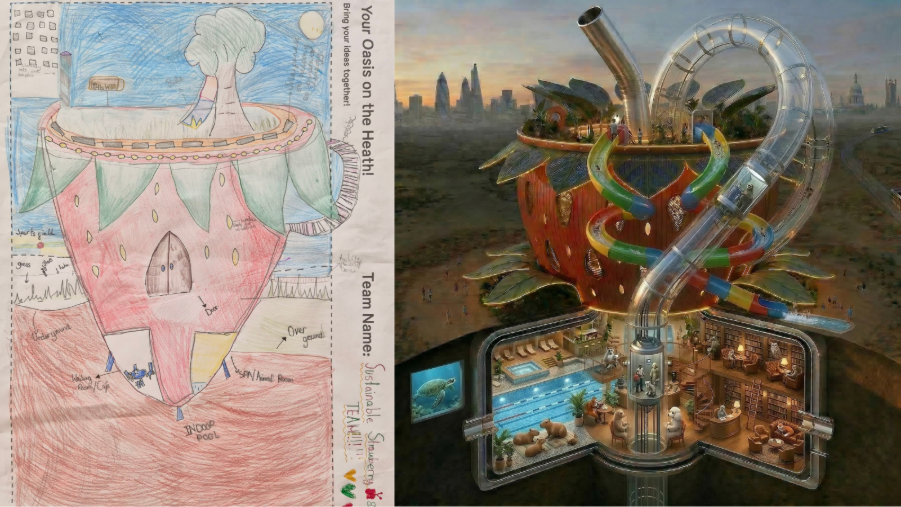
The Sustainable Strawberry group’s design (left) rendered by Sheppard Robson Architects using AI (right)
The children impressed the panel of experts listening to their presentations. They heard the children describe the patient’s experience of the building as well as the building’s features, including underground transport tunnels and even “ski-lifts” to ensure patients can move comfortably between the hospital and the new landscape.
Beyond learning technical skills, an impactful takeaway from the project was a shift in the students’ emotional connection to the climate crisis. While many began the workshops feeling anxious about news of floods and wildfires, the process of co-design provided them with a sense of agency. A child from the focus group said “I feel less anxious because now I know how big the problem is, and now I know that there are ways to try and make it go slower. So, we’ve got time to act.”
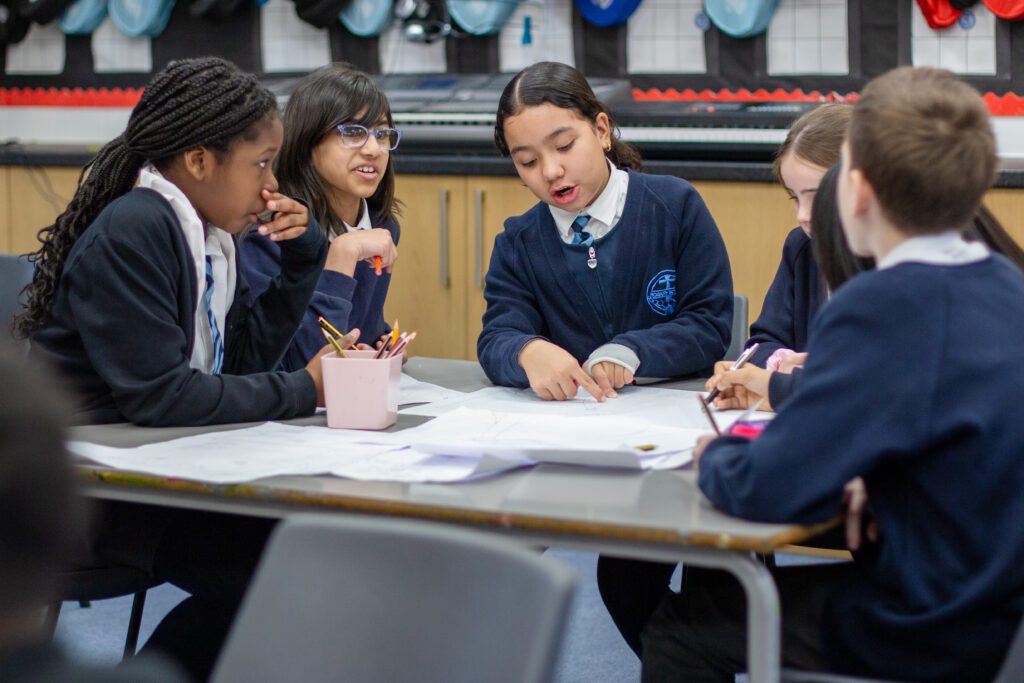
The Year-5 Pupils work in teams on their designs
The children reflected that while they now better understand the scale of climate change, they feel less overwhelmed because they sense the potential of agency over their future. As one student noted, they realised that everyone has a voice and the power to make a change, proving that when we empower the next generation with the tools of design, we move from a place of worry to a place of action. This transition was supported by the collaborative atmosphere in the classroom, where the designers maintained a calm and enthusiastic way of communicating, ensuring every child – regardless of ability – felt their contribution to their design team mattered.
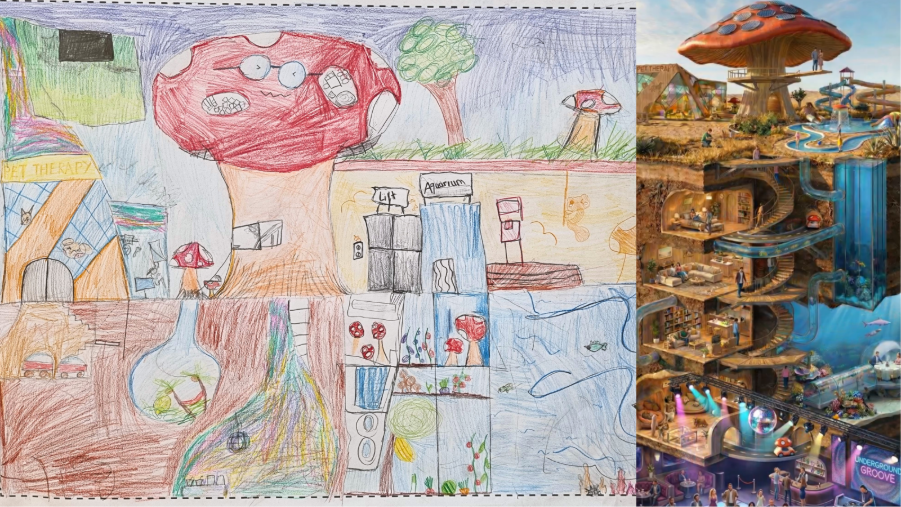
A Year-5 team’s concept design (left) rendered by Sheppard Robson Architects using AI (right)